
Our 5-Year Plan of Guaranteed Admission Programme (GAP) for the Top 10 UK Universities
Our Services (A Typical Example in 5 years)
Admission chances to the University of Oxford for local students and overseas students
-
The population of the UK is estimated at 69 million, and 9,865 British students will be admitted in 2023.
-
The population of EU countries is estimated at 449 million, but only 610 EU students were admitted. The population of the EU is 6.5 times that of the UK, but the admission rate is 16 times lower than that of the UK.
-
If you do not hold a British passport, this means the admission rate differs by more than 100 times!
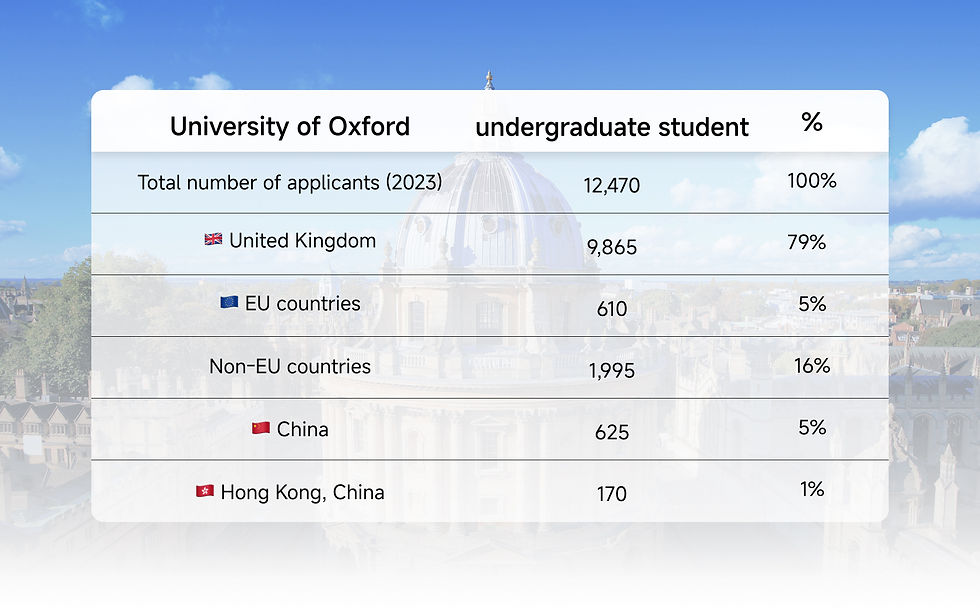
*Admission Chances to the University of Oxford for Local Students and Overseas Students in 2023
A Crucial “Short-cut” for International Students
British (UK-domiciled) applicants have a substantially higher admission rate to Oxbridge universities compared to international students, with UK applicants receiving significantly more offers than non-EU applicants. This is partly due to the historical funding of UK universities to educate local students and differences in application volume and selection criteria between international and domestic candidates.
Strategic Pathway to an Oxbridge & G5 University
To get into Oxford or Cambridge (Oxbridge), you need to achieve excellent academic grades, show a genuine passion for your chosen subject through extensive self-study and extracurriculars, perform well on subject-specific admissions tests, and shine in the crucial interview stage. All applicants submit a UCAS application by the early October deadline and must meet the specific course requirements for both universities.
Here's a step-by-step guide:
1. Maintain Top Academic Performance:
Secure exceptional grades in your high school examinations, such as A-levels or the IB.
2. Demonstrate Subject Passion:
Pursue your subject beyond the classroom by reading widely, engaging in relevant extracurricular activities, and showing you can think critically and independently.
3. Choose Your Course and College:
Research your subject options and decide on a course and a specific college, or make an open application to the university.
4. Submit a Strong UCAS Application:
Complete your UCAS application, which includes a personal statement highlighting your academic interest and suitability for your chosen course.
5. Take the Relevant Admissions Tests:
Many courses require you to sit a subject-specific admissions test to assess your aptitude.
6. Prepare for the Interview:
If your application is strong, you will be invited for interviews. Prepare to discuss your subject in depth, demonstrate your critical thinking skills, and answer questions confidently.
7. Submit Written Work (if required):
Some courses may ask you to submit examples of your written work to further demonstrate your skills and knowledge.


Guaranteed Admission Programme (GAP)for the Top 10 UK Universities (ages 10+)
If you have a clear vision of your study path in the Top 10 UK universities, consider applying for our Guaranteed Admission Programmes (GAP).
Eligibility for a GAP is determined by your academic achievements, interview and written tests.
Returning to the fundamental principles of education, it is essential to have the language immersion and cultural exposure, high quality of teachers and family support — none of which can be lacking! If families are willing to relocate or accompany their children while living in the UK, this would certainly yield the best results. Having parents nearby to support their child's growth is invaluable.
Therefore, our Guaranteed Admission Programme (GAP) significantly enhance opportunities for future university applications to the Top 10 UK Universities successfully, primarily aims to provide academic and experiential courses for our targeted pupils starting from upper primary or junior high school.
Core Subjects

English

Maths

Science

STEM
Supplementary Subjects

Physics

Chemistry

Biology

Additional Maths

Computer Science

Business Studies

History

Psychology

Geography

Mother tongue (such as Chinese)
UK Top 10 Universities Courses

Oxbridge Mentorship Programme

Oxbridge University Application Workshop

Internship Opportunities in the UK G5 Universities

UCAS Programme

Personal Statement

Mock Interview Practice

Accelerating IELTS Course
Super Curriculum Programmes

Family and Children Counselling Workshop

Life Skills and Leadership Workshops

Extended Project Qualification, EPQ

International Recognized Competitions

Critical Thinking, Debate and Writing Skills

Career Experiential Summer Camp in the UK and Dubai

Career Guidance Seminars
Excellent GCSE grades are important for Oxbridge, but they are just one factor among many in an application, which also includes predicted A-level grades, university-specific admission tests, a strong personal statement, and performance at interview. While most applicants to Oxford and Cambridge have top grades across the board, particularly for competitive courses like Medicine, exceptional performance in other areas can compensate for any minor weaknesses in GCSEs.
In summary: If you have excellent GCSEs, you have a good academic foundation for an Oxbridge application. However, focus on achieving excellent predicted A-level grades and preparing thoroughly for admission tests and interviews, as these elements will have a greater influence on your chances of securing a conditional offer. For the Medicine course at Oxford, there's a government restriction on the number of international fee-paying students who can be admitted each year, which affects the admission rates for international applicants in this specific field.

Highly recommend to take at least 12 subjects in GCSE
University Admissions Tests
Many of the top universities also require candidates to sit their own university admissions tests which candidates take in addition to A-Levels for examples include the BMAT, UCAT, PAT, LNAT, TSA and STEP.
Step 1 – Assess the Student’s needs
Assessment is done annually to ensure that student is on path for top university

Psychological Assessment
To assess student’s strengths, weaknesses and appitudes. Advise on how to motivate student to develop own interests.

Academic Assessment
To assess student’s academic strengths and weaknesses in order to best know where to support them in order to reach academic goal

Super Curriculum Audit
To gain an understanding of what Super Curricula activities the students participates in and how to support him/her to write an excellent Personal Statement and build the skills to participate in a University Interview.
Step 2 – Provide a Tailored Course that meets the needs of each individual student and will allow him/her to meet the requirements for Top 10 UK University
Example of a Programme for a Year 9 student thinking of studying Economics. This student is strong academically and has good English but needs to build up knowledge and skills for Personal Statement, Interview and University Admissions Tests
Foundation & Exploration
300 hours of teaching hours
200 hours one-to-one online, 100 hours in UK, China, Hong Kong, Japan, Korea, Dubai and/or Abu Dhabi in small groups
Academic Enrichment
Oxbridge Reading Club – Read and Discuss with our Academic Oxbridge Team
Start with accessible economics and finance books
-
“Freakonomics” by Levitt & Dubner
-
“The Undercover Economist” by Tim Harford
-
“Economics: A Very Short Introduction” by Partha Dasgupta
Recognised Competitions
Maths Focus: UKMT Junior Mathematical Challenge (JMC)
Skills Development
Lamda Public Speaking
Ongoing Across All Years
-
Keep a Super-Curriculum Portfolio (journal, Google Doc, scrapbook):
-
Log books read, notes from talks, ideas from courses
-
Reflect on why these experiences mattered
-
-
Develop soft skills:
-
Time management, resilience, note-taking, summarising, questioning
-
A Guide to the Paths Leading to Oxford, Cambridge, the Ivy League, and Top Universities in the UK/US
